

An entirely unreasonable request
This morning, I received a letter from the DWP informing me that we had failed to make deductions from a worker’s wages under an Attachment of Earnings Order.
Now, as a recruitment agency providing temporary workers to businesses across Sussex and beyond, we’re quite accustomed to receiving these instructions. We have a legal obligation to administer them, and there can be financial penalties for failing to comply. That’s entirely reasonable. The system exists for a purpose, and businesses have a responsibility to play their part.
There is, however, a small problem.
Quite frequently, by the time the DWP gets around to telling us that it wants deductions made from someone’s wages, that person has already left our payroll. Sometimes several months earlier. We have issued their P45, processed their final wages and wished them well in their next role. We’ve even notified HMRC through the government’s own Real Time Information (RTI) payroll reporting system. Unfortunately, government departments don’t always appear particularly good at talking to one another, and invariably nobody seems to have told the DWP.
So we receive a letter instructing us to deduct money from wages we are no longer paying. A few months later, we may receive another letter asking why we haven’t complied with the first.
The answer, of course, is that the worker isn’t with ASL anymore. I appreciate this may be a difficult concept for a government department to grasp, but it does rather complicate the business of deducting money from someone’s wages.
But today was different!
Today, rather unusually, the worker concerned was actually still on our payroll. This came as something of a surprise.
On investigating, it appeared that we hadn’t received the original instructions, so I decided to contact the DWP and ask them to send us the information we needed to make the deductions. Simple enough, you’d think. After all, we’re in 2026. Surely communicating with a government department that has such a love of all things digital wouldn’t present any particular difficulties?
How wrong I was.
Welcome to the digital revolution. Terms and conditions apply.
The DWP does provide a telephone number. Unfortunately, my previous experience suggests that getting someone to answer it can take anywhere between 30 and 45 minutes. I tried calling this morning, but after approximately 15 minutes listening to the telephone system, I decided that life was too short.
Perhaps I could send an email?
No.
Perhaps there was an online portal where businesses could securely communicate about these matters?
Apparently not.
Perhaps I could send a fax?
Ah, now there’s an interesting thought.
For years, the fax machine was the dependable workhorse of communication with government departments. Admittedly, it was hardly cutting-edge technology, but it had one enormous advantage.
It worked.
You put a document in one end, pressed a button, and a few moments later it appeared at the other end. Unfortunately, in a bold step towards modernisation, the DWP appears to have retired its fax facility.
And replaced it with…
Well, nothing particularly useful, as far as I can establish.
So, having exhausted the technological possibilities available to me, I did what any sensible business owner in the third decade of the 21st century would do.
I wrote a letter.
I printed it, found an envelope, addressed it and walked to the post office, where I purchased a second-class stamp for the princely sum of 91p. I think this is only the second piece of business correspondence I’ve actually posted this year.
It was genuinely quicker to carry a piece of paper through the streets of Hastings than to wait for someone at the DWP to answer the telephone.
Nearly 40 years after I first encountered recruitment agencies delivering CVs on foot, it seems I’ve come full circle. I’m delivering business correspondence on foot again.
I’m not entirely convinced this is what the government means when it talks about improving productivity.
The cost of doing business
Of course, there is a serious point behind all this. Businesses are legally obliged to administer these deductions, and rightly so. But doing so takes time, particularly when the instructions arrive late, relate to workers who have already left our payroll, or require clarification.
And whose time is being used?
Ours.
Every letter needs opening, reading, investigating and, where necessary, responding to. Every telephone call involves someone sitting on hold instead of doing something productive. Every unnecessary exchange of correspondence creates additional administration for both the business and the taxpayer.
For a recruitment agency like ours, providing temporary workers whose assignments may last anything from a few days to several months, this isn’t an occasional inconvenience. It’s a recurring part of running the business. Multiply that across thousands of businesses throughout the country, and I suspect the cumulative cost is considerable.
At a time when businesses are being encouraged to improve productivity, embrace technology and reduce unnecessary administration, it seems extraordinary that we are still expected to communicate with a major government department using envelopes and postage stamps. Particularly when that department has the power to penalise businesses for failing to comply with its instructions.
A modest proposal
Now, I appreciate that developing a modern digital communication system for a government department might be a complicated and expensive undertaking. So perhaps we should consider something simpler.
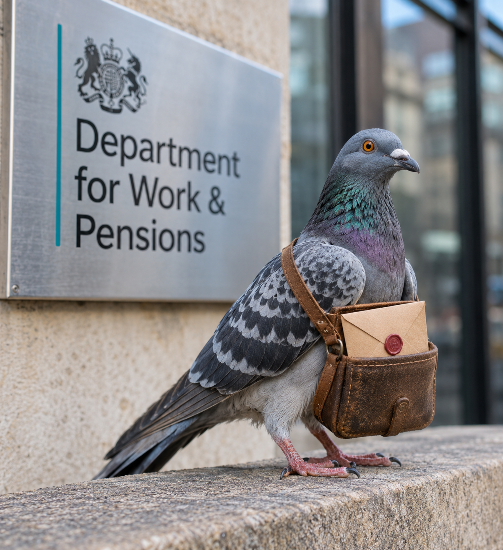
Carrier pigeons.
They have, after all, been used to deliver messages for thousands of years. They’re relatively inexpensive to operate, require no broadband connection and, with suitable training, could probably find their way to the appropriate DWP office. Alternatively, perhaps we could borrow an owl from Hogwarts. Even the Ministry of Magic seems to have developed a more efficient system of written communication than the DWP.
There would, naturally, be some administrative considerations. I imagine each pigeon would require a licence, a veterinary certificate and registration with the appropriate government department. There would probably need to be a formal application process, accompanied by proof of identity, evidence of address and perhaps a DBS check.
We would also need to consider what happens if a pigeon becomes ill, takes an unauthorised holiday or simply decides to fly somewhere more interesting.
And, of course, there’s the question of bird flu.
In the event of an outbreak, DEFRA might impose restrictions on the movement of birds, potentially bringing all correspondence with the DWP to a complete standstill.
I can already imagine the letter arriving three months later.
Dear Employer,
Our records indicate that you have failed to comply with the Attachment of Earnings Order issued on 14 August.
Please explain why the required deductions have not been made.
To which I would have to reply:
Dear DWP,
Unfortunately, our pigeon was placed under movement restrictions following an outbreak of avian influenza. We subsequently issued its P45, and it is no longer on our payroll.
We trust this clarifies the position.
Naturally, the DWP would then write back asking why we hadn’t made deductions from the pigeon’s final wages.
Perhaps there’s another solution?
On reflection, perhaps the carrier pigeon scheme is unnecessarily complicated. There would be licences to issue, veterinary inspections to arrange, pigeon lofts to construct and an entirely new government department required to oversee the whole operation.
And I suspect that, within a few years, businesses would be required to complete an annual Pigeon Compliance Return, with financial penalties for failing to maintain accurate records of their birds.
So perhaps we should consider something altogether more radical. Something that would allow businesses to communicate instantly, provide written records of correspondence and avoid unnecessary postage costs. Something that most of us have been using successfully for the best part of three decades.
An email address.
I appreciate it’s a rather revolutionary suggestion. But perhaps it’s worth considering.
And if anyone at the DWP would like to discuss it, they’re very welcome to get in touch.
Although I would appreciate it if they didn’t write to me.
Image: AI-generated illustration created for ASL Recruitment. No pigeons were employed in the making of this image.