
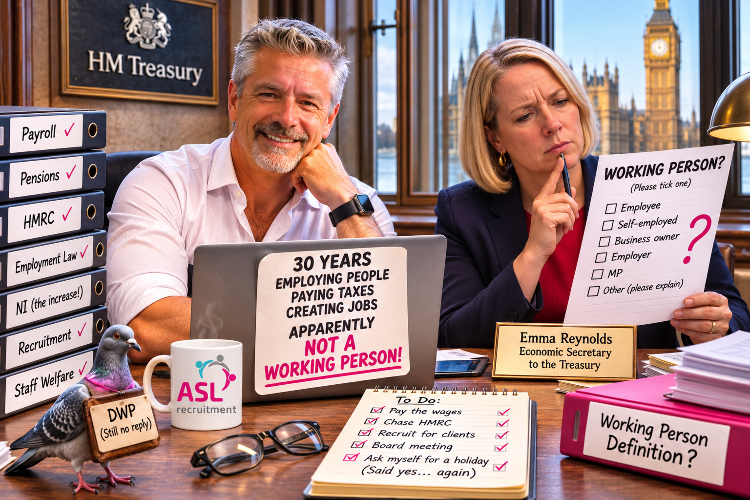

When Does a Working Person Stop Working?
Consider someone who has spent years working as an employee, saving their money and dreaming of starting their own business. Eventually, they take the plunge. They invest their savings, perhaps remortgage their house, and open a small café, workshop or shop. They work six days a week, arrive before their employees and leave after them. They spend their evenings dealing with paperwork, worrying about cash flow and wondering whether they’ll have enough money to pay everyone at the end of the month. But apparently, somewhere between ordering the coffee beans and employing their first barista, they may have stopped being a working person.
And what happens if the business fails? Does the owner automatically regain their working person status? Is there a cooling-off period? Do they have to surrender the top hat? I imagine there’s a government department responsible for deciding these things, although I suspect nobody has yet managed to get through to them on the telephone.
A Quick Question About Holidays
While we’re clarifying my employment status, perhaps you could also help with a question about annual leave. As someone who apparently isn’t a working person, I’m not entirely sure whether I’m entitled to holidays. I do occasionally manage to escape the office for a week or two, although I’ve yet to discover how to do so without taking my laptop with me. Apparently, being on holiday doesn’t stop customers needing answers, employees having questions or the occasional crisis requiring attention. I’ve answered emails from beaches, dealt with payroll queries from hotel rooms and attended meetings from places where the only sensible business decision should have been whether to order another drink.
People occasionally ask me whether I can take a day off whenever I like, being my own boss. And of course, the answer is yes. In fact, I’ve developed a remarkably efficient holiday approval process.
I’ve asked myself for the day off. I said yes.
No forms, no HR department, no waiting for authorisation. Just a quick conversation with myself and the matter is settled. Unfortunately, I then remember that there’s work to be done, so I take my laptop with me anyway.
But then, I suppose that’s one of the great privileges of not being a working person. You never actually have to stop working.
Perhaps We Should Ask Our MPs?
Of course, Emma, this raises another interesting question. Are Members of Parliament working people?
Now, before anyone gets too excited, I’m not suggesting MPs don’t work. I’m sure many of them work extremely hard, often dealing with demanding constituents, complicated legislation and the unenviable task of trying to keep everyone happy. Having spent thirty years dealing with employees, customers and government departments, I have some sympathy for anyone whose job involves trying to satisfy people with completely contradictory expectations.
But the distinction does become rather entertaining when you consider that MPs receive a salary, have access to a pension scheme, employ staff and, in some cases, hold other paid positions alongside their parliamentary responsibilities. Some have previously run businesses, while others continue to have business interests. So are they working people, employers, both or neither? And if an MP employs someone to answer their emails, does that mean they’ve crossed over to the other side?
Perhaps the House of Commons could establish a Select Committee to investigate. It could spend eighteen months taking evidence, publish a 400-page report and recommend the creation of an independent Working Person Classification Authority. Naturally, it would need a chief executive, a substantial administrative budget and a dedicated team to establish whether the chief executive was actually a working person.
I suspect the answer would depend on which department you asked.
The Strange Business of Employing People
The reality of running a small business is rather less glamorous than the popular caricature suggests. Most business owners I know don’t spend their days contemplating which yacht to purchase next. They’re dealing with customers, suppliers, employees, regulations, rising costs and the occasional sleepless night wondering whether everything will come together. Some earn considerably less than the people they employ, particularly in the early years, and many have put their own savings, homes and financial security at risk to create something.
That doesn’t make them more deserving than their employees. It simply makes them people who work, albeit with a different set of responsibilities.
And here’s something that sometimes seems to get overlooked. Employers don’t exist in isolation from employees. Successful businesses need good people, and good people need successful businesses. At ASL Recruitment, we see that relationship every day. We work with businesses that need people to help them grow, and with individuals who need those businesses to provide opportunities, wages and careers. Neither side is the enemy of the other. In fact, when the relationship works properly, both sides benefit.
Of course, there are bad employers, just as there are difficult employees. There are businesses that exploit people and employees who take advantage of their employers. But most people on both sides are simply trying to do a decent job, earn a living and get through the week without another unexpected letter from HMRC.
A Little Less Division, Perhaps?
I understand why politicians talk about working people. It’s a useful phrase, particularly when making promises about taxation, wages and living standards. But the difficulty comes when language intended to recognise one group of people starts to imply that another group somehow contributes less.
The person working on a production line is a working person. So is the engineer maintaining the machinery, the supervisor organising the shift and the business owner who invested in the factory in the first place. Their responsibilities may be different, their earnings may be different and their working hours may be different, but they’re all contributing to the same enterprise.
And when government makes decisions that increase the cost of employing people, those decisions don’t just affect the people signing the cheques. They can affect recruitment, investment, pay rises and the opportunities available to employees. We’ve already seen the impact of increased employers’ National Insurance contributions, which have added another cost to employing people at precisely the time many businesses are struggling with an already challenging economic environment.
You don’t have to agree with every business owner, or support every business policy, to recognise that making it harder to employ people is unlikely to make life easier for those looking for work.
Perhaps we could spend a little less time deciding which people qualify as working people and a little more time creating an environment in which everyone who wants to work has the opportunity to do so.
An Application for Working Person Status
So, Emma, in the meantime, I shall continue turning up for work, paying wages, collecting taxes, administering pensions, complying with employment legislation and doing my best to keep a couple of businesses running. I may even find time to do some recruitment, which is, after all, what we’re supposed to be doing.
If you could confirm whether these activities qualify me as a working person, I’d be delighted to hear from you. I’m particularly interested to know whether there’s a minimum number of hours I need to work, whether weekends count and whether worrying about the business at three in the morning qualifies as overtime.
And if I don’t qualify, perhaps you could explain how I go about applying.
Preferably by email.
I’ve run out of pigeons.
Yours sincerely,
Jason Perry FCIPD
Managing Director
ASL Recruitment Ltd
Image: AI-generated illustration created for ASL Recruitment. No pigeons were employed in the making of this image.